

Today, everyone knows that science in many fields is advancing at cruising speed, and it is knowledge’s time. Knowledge here is the set of materials, data and tools that users and consumers can access without difficulty. Techniques and data that were once the spheres of elites have become commonplace. In fact, through many means, including technological, informational and communicational, users and consumers can collect as much data as possible for decision-making purposes. Today, a panoply of choices are open to users and consumers in their quest, and at this point, they are no longer the intended users and consumers, they are decision-makers.
General administration and its roles in contemporary affairs
Given the current business environment, general administration has a role to play in the survival of the enterprise. The general administration is the body responsible for running the enterprise with a view to sufficiently attractive operating results, sustainable and lasting perspectives and alternatives. In contrast to the supervisory board, it is the senior management represented by a single person whose mission is to make the enterprise grow and ensure its preservation. Contemporary affairs are the dynamism of the ecosystem of the business, user and consumer market that, today, is based on information and communication technologies.
In such a market, businesses are the producers of goods and services, and users and consumers are businesses and individuals. In contemporary affairs, not all markets are merged, however they are linked to and subject to the effects of information and communication technologies. As we have seen above, thanks to technological, informational and communication tools, users and consumers here are no longer who they are represented in the eyes of the enterprise or the producer, they are decision-makers. At this point, the question we must ask ourselves is What can we do with the enterprise or the producer to influence or convince decision-makers?
Contemporary affairs are full of know-how, knowledge and technologies that weaken the monopoly or oligopoly by allowing new entrants with offers adapted to the time. The national market is transparent, in point of fact, users and consumers, now called decision-makers, know everything that is going on in it and have data that allows them to make wise choices. To avoid decadence or queue, or to keep pace with contemporary affairs, the enterprise or producer must have a general administration that applies or follows the DDCF model as much as possible.
The DDCF model relies on the general administration or the general board of directors to develop a plan for the future of the enterprise’s profitability and continuity. It governs the enterprise’s plan for operation, development and continuous transformation. The model is simple and built from four basic elements:
- Direction;
- Delegation;
- Coordination;
- And feedback.
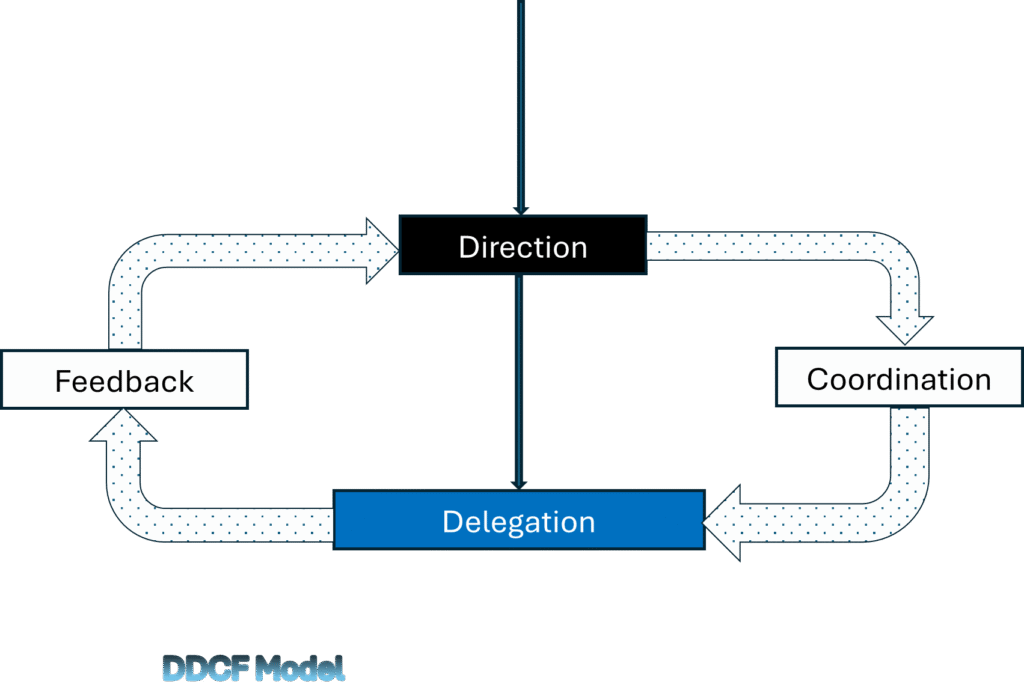
Direction: The general administration, with the support of the supervisory board if there is one, must be able or have real power to govern. That said, the enterprise’s failures and success depend on itself, i.e. its general administration model. The latter develops the enterprise’s short-, medium- and long-term objectives and, with the support of the supervisory board, if necessary, the strategies – operating methods, financial tools and channels, marketing plan, etc. – for the achievement of those objectives. Strategies that are merely the means put in place to achieve the objectives must be flexible enough to allow adaptation and/or change when necessary.
Delegation: The general administration does not have expertise in all areas depending on the type of business operated, which is why the delegation of power to resource people – empowerment – is inevitable. The latter must be or are called upon to manage and not administer the branches, departments, etc., of the enterprise. In their opinion, the strategies put in place may or must be modified to allow the optimal desired result.
Coordination: The general administration must use a transversal coordination model allowing harmonization between branches, departments and the different elements of the enterprise. At this point, the enterprise is seen as a harmonious whole where its different parts form a chain. If one of its links manages to break, the effect will have to be felt throughout the enterprise. This is where you see the management practice of the enterprise, its leadership, its principles and code of conduct, its culture, et cetera.
Feedback: As the modes of operations used by the enterprise unfold, it needs feedback as a means of control to correct imperfections and adapt its management model to the needs of the hour. Feedback is a dashboard based on indicators and benchmarks to see if the enterprise’s objectives are being met and if the enterprise itself is on the right track. Feedback should come from two environments: internal and external.
Internally, if the results are in line with the established objectives, the general administration may consider investing more in its human resources and the development of the enterprise through its budgets for compensation, research, etc., on the other hand, it must take drastic measures to correct imperfections and/or inconveniences by means of dismissal, change of operations, et cetera.
The feedback that comes from the outside must be clear enough to give the general administration a clear idea of what is happening in the market. This will allow them to know in time the introduction of new technologies in the sector and new ways of doing things adapted to the time, including changes in consumer needs and behavior. From then on, the enterprise will know how to react and act to avoid losing market share or seeing its customer base fall.
In conclusion, the DDCF model assumes that the general administration must be proactive or foresighted with respect to its internal and external environments, and its modes of operation must rely on technology and continuous transformation to be or remain in contemporary affairs.


One thought on “The General Administration of Contemporary Affairs”
Comments are closed.