
The corporate finance department is important in the same way as the general administration or the executive management of the company, the small nuance here is that it is preferably headed by the general administration. Not all businesses have a finance department, as such a department is subject to human and budgetary resource constraints. Only large SMEs and large companies have a finance department.
In micro and small enterprises, the owner or entrepreneur and/or the manager or head simplifies the functions of financial management with the duty of control and accounting. However, the control mentioned here is subject to accounting, and in these circles, we are dealing only with operations related to financial accounting by means of accounting books, software, etc., and not with the office that deals with the financial affairs of the company. For the most part, it is the head of the business who fulfills this or these function(s).
In medium and large enterprises MLEs, the finance department is set up for the management of accounting and financial affairs. Its mission is to administer and manage the financial affairs of the company, and this is what makes it so important. Internally, it exercises its financial management powers over all departments or sections through its financial control module; from the general board of directors, if the company has it, that it serves as an advisor to the simple expense of buying paper for the printers.
The corporate finance department carries out its financial control and management functions through the expertise of resource people such as the controller, the chief accountant, the treasurer, the auditor, the financial analyst, the planner, et cetera. As a result, the control and management services of the finance department rigorously extend all operations related to the company’s income and expenditure. All the departments or sections of the company need the money to function, thereby the finance department extends its actions to all of them.
As you know, the chief financial officer, who is the head of the finance department, since the controller, the chief accountant, etc., are directors, and/or one of his assistant directors can bring people from other departments into his or their office to question them on matters related to the company’s revenue and expenditure operations. During meetings or meetings of the company’s directors, the voice of the CFO is one of the most listened to or important.
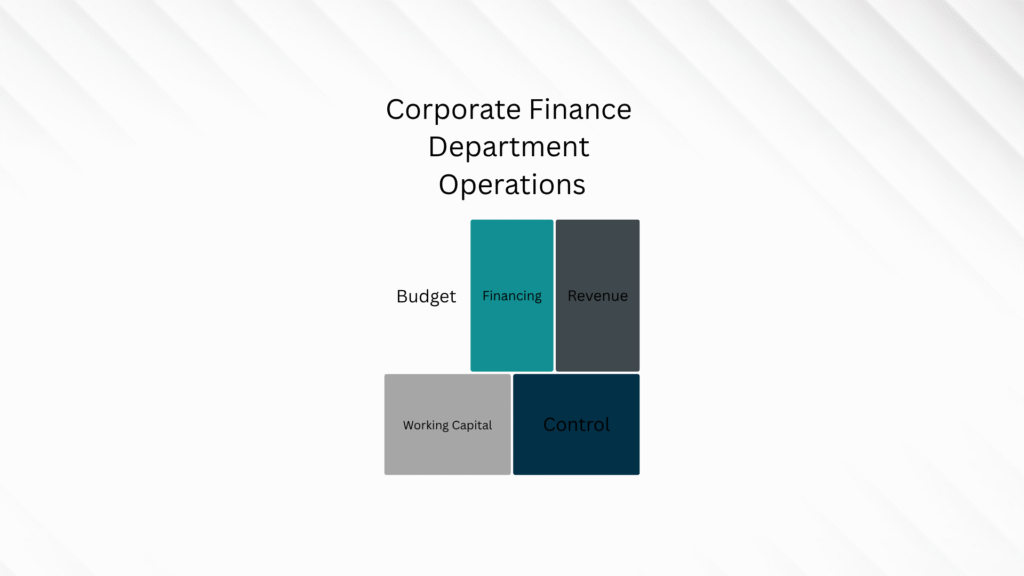
From what has been said above, the corporate finance department groups its operations into five categories: Budget, Financing, Revenue, Working Capital, and Control. As a matter of fact, it participates in the development of strategies and develops the company’s financial strategies in accordance with taxation and the objectives established by the general administration. At this point, it intervenes mainly upstream through budget and financing operations.
Externally, the corporate finance department remains up to date with the market as it evolves in terms of tax and other regulations. As the guarantor of the company’s good financial health, it intervenes upstream and downstream to ensure the profitability of the company. For example, without the advice of the marketing or sales department, it can block or close customer accounts if it deems that they are not in line with the company’s financial strategies, it can have a particular product withdrawn from the market if it does not think it is profitable for the company, et cetera.
Internally and externally, the corporate finance department is also an executive and decision-making body that controls the company’s operations to ensure that it is profitable and solvent. It also plays a proactive role in the actions to be taken to optimize the company’s activities and ensure its sustainability. So important, in times of crisis and/or upheaval, it is the ideal body to be able to act to allow the company to be resilient.